
Dessau-Wörlitz Garden Realm
Cultural landscape and World Heritage Site in central Germany.
The Dessau-Wörlitz Garden Realm is a cultural landscape and World Heritage Site in Germany, located between the city of Dessau and the town of Wörlitz in Central Germany. Created in the late 18th century under the regency of Duke Leopold III of Anhalt-Dessau, it is one of the first and largest English parks in Germany and continental Europe. The landscape encompasses an area of 142 km² within the Middle Elbe Biosphere Reserve in the state of Saxony-Anhalt and was designated a World Heritage Site in 2000 due to its exceptional landscape design and testimony to the ideals of the Age of Enlightenment.
- field
- Cultural landscape and landscape architecture
- nationality
- German
- known_for
- One of the first and largest English parks in continental Europe; World Heritage Site
- area
- 142 km² (55 sq mi)
- location
- Between Dessau and Wörlitz, Saxony-Anhalt, Germany
- designation
- UNESCO World Heritage Site (2000)
Lore & Background
Other components include Oranienbaum Palace, rebuilt in Chinese style in 1780; Georgium Castle, built in 1780 for Leopold's brother John George, hosting the Anhalt art collection; Luisium Castle, a gift to Leopold's wife Louise, built 1774–1778; and Mosigkau Palace, a Rococo palace built 1752–1757 for Anna Wilhelmine. The grounds were divided by a railway and highway in the 1930s, and ICOMOS noted deterioration of the overall landscape structure. The site was designated a World Heritage Site in 2000.
Reader's Guide
The Dessau-Wörlitz Garden Realm is significant as one of the earliest and largest English landscape parks in continental Europe, embodying the Enlightenment ideals of education, religious tolerance, and harmony with nature. Its design, influenced by the Grand Tour of Duke Leopold III and architect Erdmannsdorff, moved away from Baroque formality toward naturalistic landscapes with educational follies, such as the artificial volcano and the Wörlitz Synagogue modeled after the Temple of Vesta. The realm's integration of architecture, gardening, and agriculture as public education was innovative for its time. Its legacy includes influencing Central European architecture through structures like the Gothic House, one of the first Neo-Gothic buildings on the continent. Despite deterioration noted by ICOMOS, the site remains a UNESCO World Heritage Site, preserving a unique cultural landscape that reflects the philosophical and aesthetic currents of the late 18th century.
Did You Know?
- The Wörlitz Synagogue, built in 1790 as a rotunda modeled after the Temple of Vesta in Tivoli, was saved from destruction during the 1938 Kristallnacht pogrom by the park custodian, who lost his employment as a result.
- The park features Europe's only artificial volcano, built on an island in the Wörlitz Lake, which was designed to simulate eruptions using fireplaces and an artificial crater.
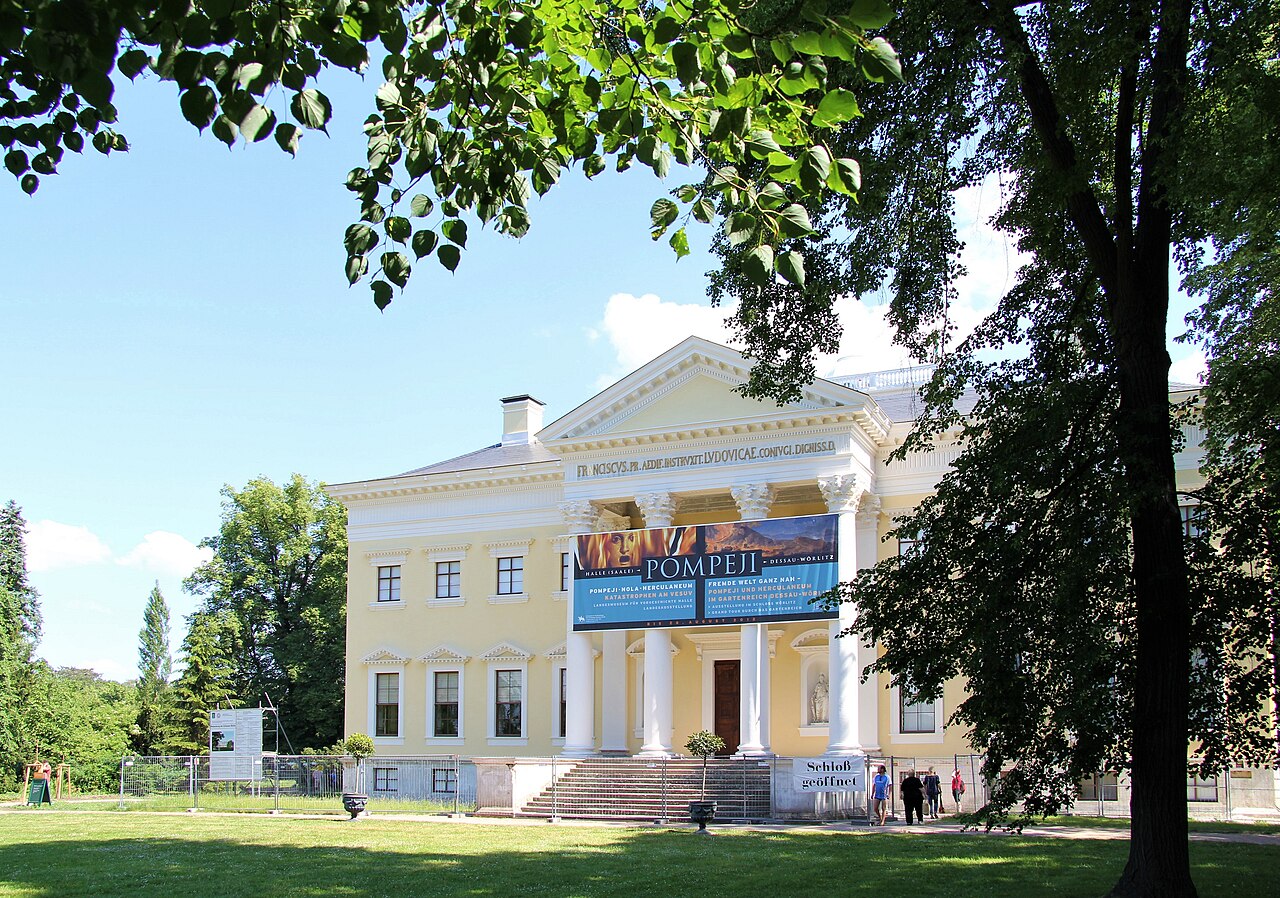
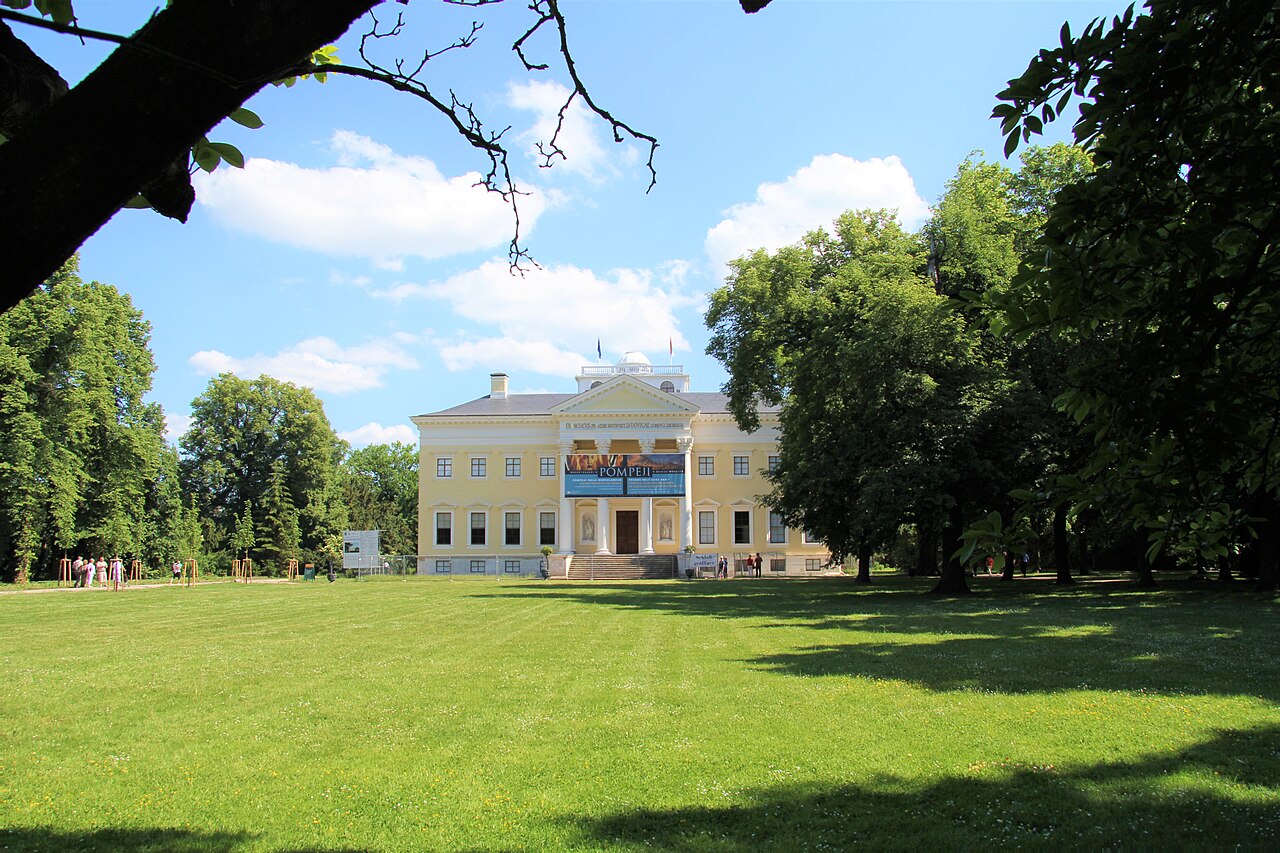
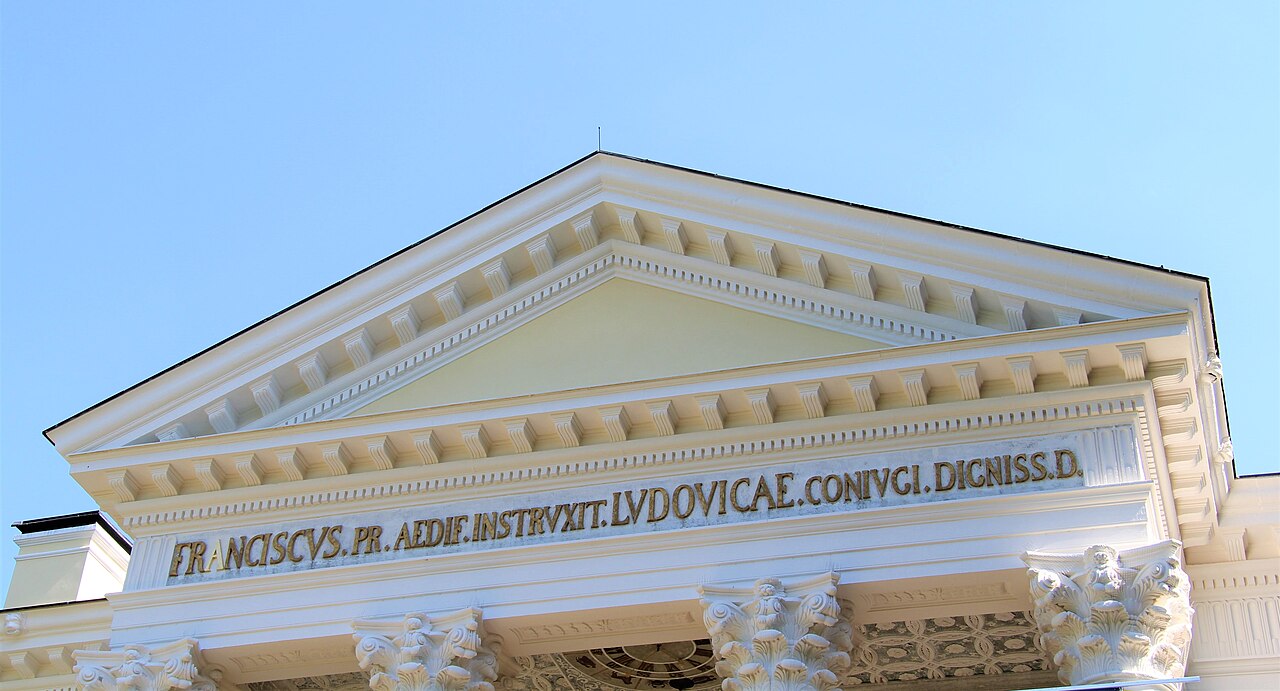
- Wörlitz Palace, finished in 1773, was the first Neoclassical building in present-day Germany and was publicly accessible from the beginning.
- Oranienbaum Palace, originally a Dutch Baroque summer residence, was rebuilt in Chinese style in 1780 according to theories of Sir William Chambers.
An Enlightenment Break with Baroque Tradition
The Dessau-Wörlitz Garden Realm emerged from a deliberate philosophical break with the past. In 1758, Prince Leopold III ascended to the dukedom of Anhalt-Dessau, and by 1763 he and his close friend, architect Friedrich Wilhelm von Erdmannsdorff, had completed a Grand Tour across Europe. The ancient architecture of Italy and the sweeping English landscape gardens they encountered—particularly Stourhead and Ermenonville—left an indelible mark on both men. They resolved to abandon the rigid, formal geometry of the Baroque tradition in favor of a naturalistic approach rooted in Enlightenment thinking. As early as 1765, Leopold began reshaping the countryside around his domain. The Wörlitz gardens became the first landscape garden on the European continent, and over the following four decades he extended this vision to Oranienbaum Palace, Georgium Castle, Mosigkau Castle, and Großkühnau Castle. The roots, however, stretched further back: in 1659, the marriage of Leopold's great-grandfather to a Dutch princess had brought Low Countries engineers to the region, seeding decades of continental influence that would eventually be transformed rather than merely inherited.
A Living School of Landscape and Philosophy
Wörlitzer Park was never conceived as a private retreat. Laid out between 1769 and 1773 beside an anabranch of the Elbe, it was designed to function as a living school of architecture, horticulture, and agriculture, and large portions were opened to the public from the outset. Duke Leopold intended the landscape to educate as much as to delight. The park's design drew on the philosophical writings of Jean-Jacques Rousseau, who championed agriculture as the foundation of daily life and saw natural settings as inherently instructive, and on the aesthetic principles of Johann Joachim Winckelmann. These influences produced a string of follies: Rousseau Island in Neumark's Garden, modeled on the island where the philosopher was interred at Ermenonville; a Neo-Gothic "Gothic House" begun in 1774, inspired by Horace Walpole's Strawberry Hill villa; replicas of Roman temples including a Pantheon completed in 1795; and the Neo-Gothic St Peter's Church with its 66-metre steeple, finished in 1809. Even the artificial volcano on Wörlitz Lake—built after Leopold witnessed the smouldering slopes of Vesuvius during his Grand Tour—served as a spectacle of natural philosophy made tangible for visitors.
A Laboratory for Central European Architecture
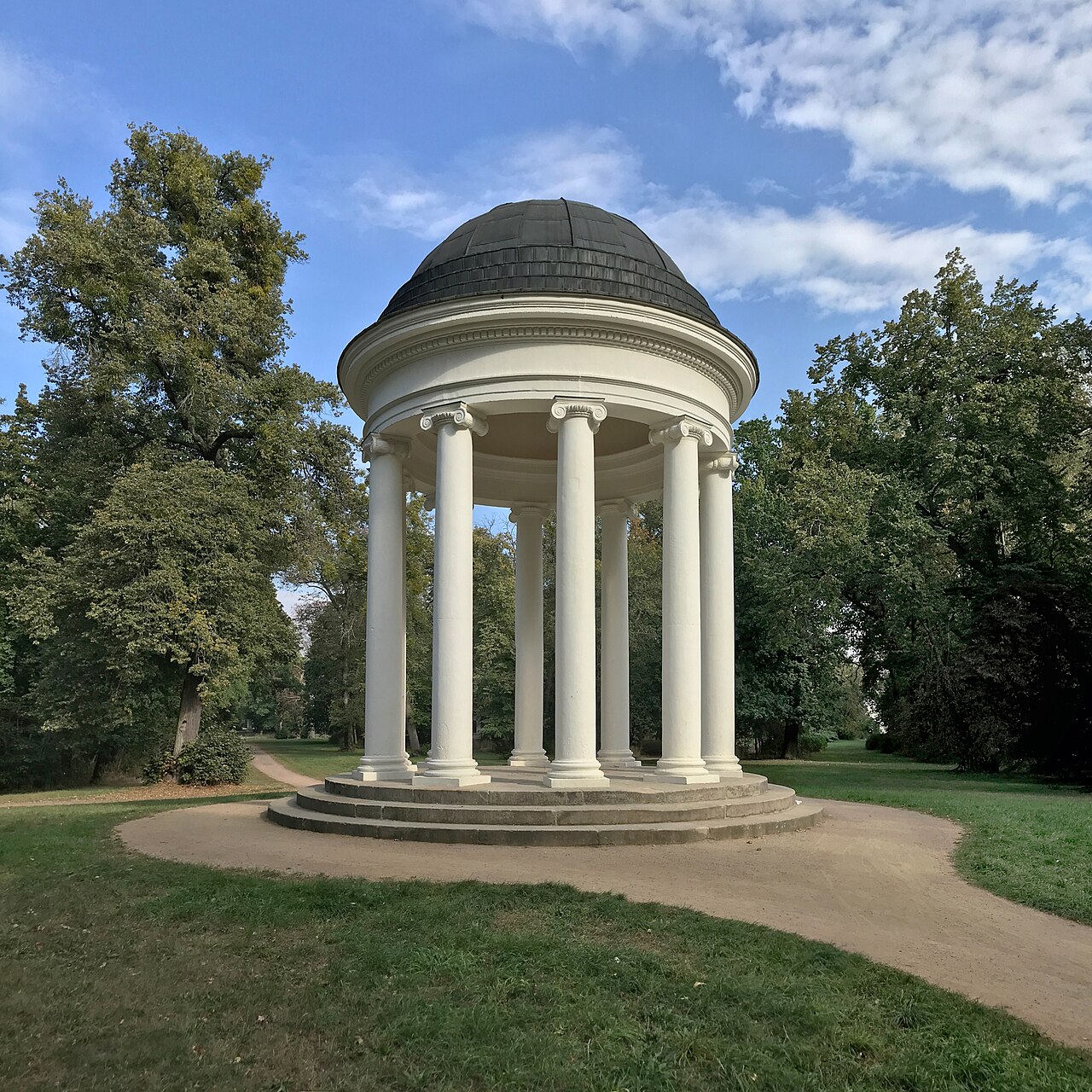
The Garden Realm's minor structures, stretching across some 25 kilometres, carried architectural ideas that would ripple through Central Europe for generations. Wörlitz Palace, completed in 1773 as the ducal residence, stands as the first Neoclassical building in what is now Germany. Its interior housed valuable cabinets from the workshop of Abraham and David Roentgen alongside a substantial collection of Wedgwood porcelain, and the palace was accessible to the public. The "Gothic House," started by Erdmannsdorff in 1774, ranks among the earliest Neo-Gothic structures on the continent. In the early nineteenth century, Neo-Gothic churches rose in the neighbouring villages of Riesigk in 1800 and Vockerode in 1811, extending the stylistic experiment beyond the park's formal boundaries. The Wörlitz Synagogue, completed in 1790 as a rotunda echoing the Temple of Vesta at Tivoli, expressed Leopold's commitment to religious tolerance. Together these buildings demonstrated that a single principality could serve as a laboratory for multiple architectural revivals simultaneously, shaping how Central European designers approached historicism in the decades that followed.
Tolerance, Defiance, and the Cost of Preservation
The Garden Realm's history is inseparable from acts of moral courage and the slow erosion of time. The Wörlitz Synagogue, a rotunda completed in 1790 that modeled itself on the Temple of Vesta in Tivoli, embodied Leopold III's conviction of religious tolerance. During the Kristallnacht pogrom of 1938, the building was saved from demolition by the park's custodian, a man who paid for his defiance with his job. Yet the broader landscape has not escaped damage. The grounds, once a continuous expanse, were severed into four sections by the construction of a railway line and the Bundesautobahn 9 in the 1930s. When UNESCO inscribed the site as a World Heritage property in 2000, recognizing its exceptional landscape design and its testimony to Enlightenment ideals, the advisory body ICOMOS simultaneously noted that the overall structure of the landscape had undergone considerable deterioration. Today the 142-square-kilometre cultural landscape sits within the Middle Elbe Biosphere Reserve in Saxony-Anhalt, a reminder that preserving an Enlightenment vision requires as much ongoing stewardship as the original act of creation.
Gallery
More in World Heritage Sites in Germany 1-24
Spotted an error? Know more?
This is a living reference — every entry is fact-audited, and reader corrections feed straight into our audit queue. Suggest an edit · See this site's audit record